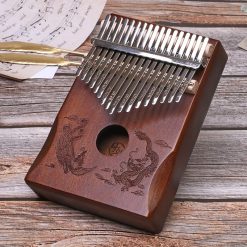
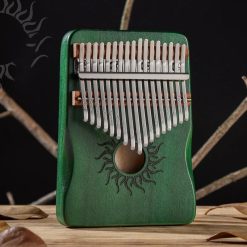
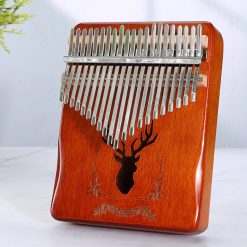
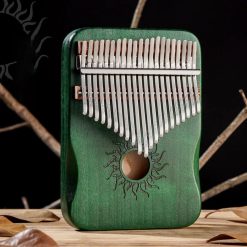
Kalimba: 17-Key and 21-Key Thumb Pianos
The kalimba, also known as the thumb piano, mbira or sanza, is one of the rare instruments you can play within minutes, with no music theory and no teacher. Here you will find our selection of wooden 17-key and 21-key kalimbas, tuned to C major and ready to play out of the box. Carved models, colourful finishes, travel-friendly formats: every instrument is chosen for the accuracy of its keys and the warmth of its resonance. Free shipping.
Kalimba is part of our guitar accessories and companion instruments department, alongside harmonicas, kazoos, ocarinas and flutes and guitars for children.
What exactly is a kalimba?
The kalimba belongs to the family of lamellophones, African idiophones whose sound comes from the vibration of thin metal keys, also called tines, plucked with the thumbs. The principle is thousands of years old: a wooden resonating body, a bridge, a pressure bar, and keys of varying lengths. The shorter the key, the higher the note. The longer it is, the deeper the sound.
Its modern version, popularised in the twentieth century under the name kalimba, has kept that radical simplicity. There is nothing to tune, nothing to plug in and nothing to learn before you produce a clean note. That explains its success with complete beginners, with children, with fans of relaxation music, and equally with guitarists looking for a different sonic texture to write with.
The keys are numbered and kalimba tabs are read as figures, not as staff notation. In other words, you can play your first recognisable tune in about ten minutes, with no musical experience at all.
17-key or 21-key kalimba: which one should you choose?
This is the first question every buyer asks, and the answer is simpler than it looks.
| Criterion |
17-key kalimba |
21-key kalimba |
| Range |
Around two and a half octaves, ample for the vast majority of tabs available online |
Roughly three octaves, with additional high notes |
| Ideal for |
Beginners, children, gifts, occasional players |
Regular players, demanding covers, richer arrangements |
| Playing comfort |
Wider key spacing, easier to locate with the thumb |
Keys sit closer together, slightly more precision required |
| Size |
Compact format, slips into a bag |
Slightly wider and heavier |
| Repertoire |
Almost every kalimba tab in circulation |
The same, plus pieces that climb into the higher register |
Our recommendation: if this is your first kalimba or if you are buying a gift, go for a 17-key model. It is the worldwide standard, the one nearly every tab is written for, and the most comfortable format for learning where to place your thumbs. The 21-key becomes worthwhile once you play regularly and want to widen your palette without changing instrument.
Our kalimba models at a glance
How do you play the kalimba?
You hold the instrument in both hands, the body resting in your palms, thumbs free above the keys. A thumb comes down on a key, releases it, and the note rings out. That is all there is to it.
- Find the central keys. On a kalimba tuned to C major, the longest key, in the middle, is your anchor point. The notes then rise alternately, one to the left, one to the right.
- Use the edge of your nail rather than the pad of your thumb: the attack is cleaner and the tone more crystalline. If your nails are short, soft thumb picks do the job perfectly.
- Read a number tab. Each key carries a number, often engraved or printed on the key itself. Kalimba tabs read as a sequence of figures, with no staff and no treble clef.
- Add chords. Two or three keys plucked at once are enough to create an accompaniment. That is where the instrument becomes truly musical.
The kalimba is tuned to diatonic C major, the most universal scale of all. In practice this means that almost anything you play at random sounds right, and that the vast majority of popular melodies, film themes and lullabies fall naturally under your thumbs.
Tuning and caring for your kalimba
A kalimba arrives tuned, but the keys can shift slightly with changes in humidity or during transport. Correcting them takes a minute.
- To raise a note: shorten the free part of the key by sliding it upwards, using light taps of the tuning hammer.
- To lower a note: lengthen the free part by pushing the key downwards, again with gentle taps.
- Check with a chromatic tuner or a dedicated app. A clip-on tuner designed for guitar works perfectly well on a kalimba.
- Caring for the wood: wipe the body with a dry microfibre cloth, avoid sharp temperature swings and never leave the instrument in a car in full sun.
- Caring for the keys: a quick wipe after each session is enough to slow down the oxidation caused by perspiration from your fingers.
Five criteria for choosing the right kalimba
- The number of keys. 17 to learn on and to give as a gift, 21 to widen your repertoire.
- The wood. Dense, properly dried wood gives longer resonance and a rounder tone. Lighter woods tend to produce a brighter timbre, darker woods a warmer result.
- The quality of the keys. This is the real test of tuning accuracy. Well calibrated steel keys hold their pitch, do not buzz and keep a clean sustain from one note to the next.
- Note markings. Numbered and engraved keys save a considerable amount of time in the first few weeks.
- The object itself. A kalimba lives on a coffee table, a shelf, a desk. An instrument you enjoy looking at is an instrument you pick up more often.
The kalimba, a gift that works at any age
Few instruments combine so many qualities for a gift: the price stays reasonable, the object is beautiful, it requires no prior learning and it does not disturb the neighbours. Its naturally gentle volume makes it an instrument for flats, children’s bedrooms, offices and travelling.
It appeals to three profiles in particular: absolute beginners who finally want to play something, relaxation and meditation enthusiasts drawn to its crystalline tones, and experienced musicians who use it as a secondary instrument for writing or recording. If you are unsure which model to pick, our gift card leaves the final choice to the recipient.
Frequently asked questions about the kalimba
Do you need to read music to play the kalimba?
No. Kalimba tabs are written as numbers, each number matching a numbered key on the instrument. No knowledge of music theory is needed to play your first tune.
17-key or 21-key kalimba for a beginner?
The 17-key model is the recommended standard for beginners: the keys are more widely spaced, they are easier to locate and almost every tab available online is written for that format. The 21-key model suits players who want to extend their range into the higher notes.
Does the kalimba arrive tuned?
Yes, a kalimba is tuned to C major before shipping. A slight adjustment may be needed after transport or a change in humidity: simply slide the key concerned with the tuning hammer to bring it back into tune.
From what age can you play the kalimba?
From five or six years old, provided the child’s hand is large enough to hold the body with both hands. The instrument presents no technical difficulty and its moderate volume makes it suitable for indoor use.
Is the kalimba loud?
No. Its volume is naturally gentle, comparable to that of a music box. It is one of the few acoustic instruments you can play in a flat at any hour without disturbing your neighbours.
Can you play more than traditional melodies?
Yes. Because it is tuned to a diatonic C major scale, the kalimba covers a very wide repertoire: film music, pop, folk, video game themes and lullabies. Thousands of free tabs circulate for 17-key models.
How long does it take to play properly?
A first simple melody comes together in about ten minutes. Allow a few weeks of regular practice to combine melody and accompaniment, and to play from memory without looking at the keys.
Is a kalimba of interest to a guitarist?
Absolutely. Many guitarists use one as a writing tool or as a sonic texture when recording. Its diatonic scale imposes constraints that give rise to melodic ideas quite different from those found on a guitar neck.
Continue exploring
The kalimba is listed in our guitar accessories department, which brings together every companion instrument and piece of equipment for musicians. If you like simple, portable instruments, explore our diatonic harmonicas, our kazoos, ocarinas and traditional flutes, and our collectible miniature guitars.
For younger players, our selection of guitars and ukuleles for children is a natural continuation of the musical journey a thumb piano begins. And if you already play guitar, browse our guitar straps, our string sets and our picks. Our practical guides are gathered on the Guitar-Strap.com blog.