

What are the origins of bass guitars?
The Origins of Bass Guitars
In its most innovative form, the bass, or commonly called electric bass, is a plucked string musical instrument, having almost the same appearance as the electric guitar. It offers a deeper sound resonance through a reduced number of four strings, with the exception of some five or six-string models. But just like the electric guitar, the designers of the bass were inspired by some traditional instruments straight from Africa and the Middle East.
The Prefiguration of the Electric Bass in All Its Forms
Being a relatively recent musical instrument, the electric bass drew all its splendor and tessitura from traditional African and Eastern musical instruments. Among its gems were:
- The Imzad or Anzad. It is a single-string musical instrument with a lute-like appearance. It is typical of the Tuareg population in the Sahara. It is mainly women who play this type of bowed violin.
- The single-string Molo. It is a traditional African instrument played with a plectrum. It is characterized by its very reduced number of strings, its long neck, and its cowhide body.
- The Xalam from Senegal. It is also found in West Africa. With a boat-shaped design, it is a plucked string instrument with approximately four to five strings.
- The Guembri is also native to the Gnaoua people. They are often found in North Africa. It is a type of reduced plucked string instrument.
There are so many models of plucked string instruments that prefigured the electric bass, particularly in terms of playing position. It is also a musical instrument held horizontally.
The Quest for a True Electric Bass
At the beginning of the 20th century, the double bass was the instrument par excellence for American musicians to play low notes and add pep to popular music styles such as: country, rock n’ roll, jazz, and blues.
Faced with musicians touring from city to city, it became more difficult to travel with a double bass. This piqued the ingenuity of luthiers, who tried to reduce the size of the body. However, amplification still needed to be improved, as there was a need for higher sound resonance. It was from this moment that the giants wanted to think bigger.
Around 1910, the Gibson brand launched the very first bass in history. It was the Mando Bass. This was a type of acoustic instrument very familiar to mandolins. And this also had a major sound constraint during public concerts. Everything had to be recreated, like the electric guitar models by Les Paul and companies. After twenty years of patience and research, a certain manufacturer had the idea of creating the electric bass.
Who Invented the Electric Bass?
Around 1933 to 1935, the American Paul Tutmarc began producing electric basses in his company Audiovox. The father of the bass thus created the famous electric bass: model 736 Bass Fiddle. In a cello format, it is an ultra-solid, limited edition four-string electric bass. It is adorned with a solid body and a fretboard positioned at 30°C. And for amplification, it features an electromagnetic microphone.
Subsequently, this determined designer released a second bass model. This time, he highlighted an electric bass the size of a guitar. But in vain, it had no success. While this model featured frets like electric guitars, ensuring accurate musical notes unlike double basses.
In parallel, the Gibson and Rickenbacker brands wanted to exploit the original shape of the double bass to develop an electric model. But these giants of stringed musical instruments did not achieve immediate success. It was rather around the 1950s that the music world turned back to Paul Tutmarc’s inventions.
Innovations Brought to the Electric Bass in the 20th Century
In light of the primary innovations brought by Tutmarc to the bass, manufacturing brands had no difficulty improving the design of the electric bass.
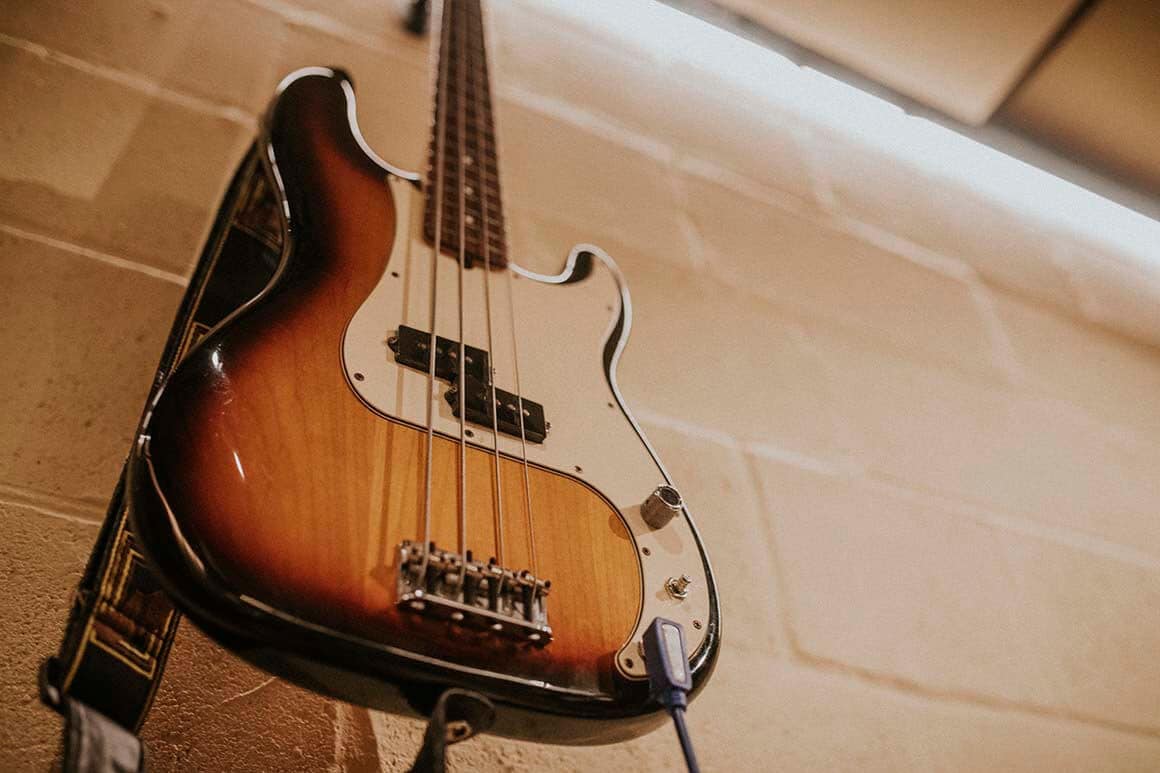
Leo Fender, a great string instrument luthier, launched his first Solidbody electric bass, or full-bodied bass, around 1951. It was the Fender Precision Bass. The Fender company thus partnered with a certain Clayton Kauffman to develop a fretted bass. This is still the subject of significant improvement over double bass models. The musical note comes out more accurate and easier to play. Being an electric and amplified model, the Fender Precision Bass features a single pickup located between the neck and the bridge. It has potentiometers for simple volume and tone adjustments. This model has proven itself extensively in Soul rhythms, offering quite impressive grooves. Great musicians and singers like The Shadows, Motown, etc., appreciated this standard Fender model.
Ten years later, Fender released the Jazz Bass model. This manufacturer made some improvements to the neck and pickup placement. In fact, Fender crafted a thinner neck. The brand therefore uses two pickups: one located at the bridge and the other at the neck. The goal is to offer good sound in the mid-range and bass. This brings even more sound quality.
The global cultural explosion around the 1960s marked the growth of the electric bass. All brands: Gibson, Höfner, Rickenbacker, and of course Fender, completely dominated the bass market. Moreover, it was at these times that the greatest artists played popular Rock music, including: The Beatles, Pink Floyd, Janis Joplin, Jimi Hendrix, Led Zeppelin, The Animals, The Rolling Stones, Bob Dylan and companies.
Then came the fretless basses around the 1970s. Just like the double bass, musicians could perform Slides or vibratos to add even more style to their music.