

What are the origins of the guitar?
The origins of the guitar
From Jimmy Hendrix to Brent Manson, and all the best guitarists in the world, the guitar is a very impressive plucked string musical instrument. It is perfect for creating musical compositions in different styles.
However, this instrument has also undergone a very long evolution before achieving its most modern appearance, as we know it today. For ages, the guitar has already been a favorite instrument of great musicians.
The origins of the guitar: by its appearance and by its year of publication?
Any form of plucked string musical instrument can be an ancestor of the guitar. For example, we can cite: the kithara, the lute, the gittern, or the vihuela. Ideas diverge among specialists as to what would be akin to the guitar.
But, did you know that the very first form of guitar appeared about 3500 years ago? Yes, the first guitar was seen in ancient Egypt during the reign of Hatshepsut. In fact, it was one of the well-known singers of that era who began playing a primitive guitar. According to researchers, this guitar initially had only 3 strings. And, it featured a cedar soundbox wrapped in leather. The Egyptians named it the Kithara. It was also a favorite instrument of the Egyptians, which then spread across various continents, from the Middle East to Western Europe.
In ancient Rome, the seven-string cithara or kithara was also played. Each string was made from animal guts. But, each country and luthier also named this original form of the guitar in their own way, including:
- For the Chaldeans, they called it the chetarah.
- The Assyrians called them ketharah.
- For the Greeks, it was a kithara.
- And for the Arabs, they named them quitāra.
Some also suggest a common trait between the Lute and the guitar, based on its basic form: a neck with a soundbox, strings, and a bridge. It was notably in Mesopotamia that the lute originated. However, the circle of specialists is not entirely convinced about this.
In the 6th century, the crwth or rote was also known. It is a Welsh stringed instrument. It had almost the same appearance as the guitar with its soundbox and neck. The crwth or crouth thus had 6 strings. With a design quite similar to the lyre, the crwth featured a closed neck style allowing one hand to press on the strings forming chords.
In the 11th century, the practice of the guitar began to spread throughout Europe, including: France, England, and Spain. Still with the same original appearance, the guitar of that era had a simple structure with external curves and plucked strings. Among the models seen in England, there was the Gittern with only 4 plucked strings.
Between the 15th and 19th centuries, the guitar began to take on an appearance quite close to its design as we know it today. At the beginning of the 15th century, the guitar had a rather short neck. It was equipped with a maximum of 8 frets. And each string was doubled or in pairs. At that time, there were two forms of guitar: the Saracen guitar or the famous lute, and the Latin guitar. In this Renaissance period, the 6-string Vihuela de Mano proliferated in Spain. Given its small size, musicians of the time could not comfortably use it in concerts. This led some to improve it to form a guitar capable of meeting the prevailing requirements: high sound resonance, etc.
It was notably from the 16th century that the true guitar appeared purely and simply in Spain, hence its Hispanic origin.
The development of the modern guitar
After undergoing various improvements, it was only in the 19th century that the guitar took on its full form: the soundbox, the flat back, the long neck, and the six plucked strings. This was notably the work of the Italian luthier Antonio Giacomo Stradivari, who added the sixth string to the guitar in pairs. And then the rest of the world also added this sixth string, reducing the whole to a single string corresponding to a precise note. From then on, a complete range of notes could be obtained on each string: E, A, D, G, B, E.
Around 1850, the Spaniard Antonio de Torres literally designed the classical guitar by making several improvements. He created a wider body. The soundboard was also improved to achieve a more significant sound volume.
From the 20th century, the guitar took off and began to be offered in various models and by several brands. Various luthiers produced classical guitars, focusing on the quality of the parts : Spruce, Rosewood, or hardwood bodies, Nylon, steel strings, etc. For example, Christian Frederick Martin is a German luthier who designed the folk guitar. Various brands have strived to create modern guitars with sublime designs such as : Yamaha, Gibson, Fender, Ibanez, Lag, PRS, etc. A wide range of guitars appeared : Acoustic, electro-acoustic, electric guitar, and bass guitar.
The birth of the electric guitar
A new variation of the guitar is the electric guitar. This guitar emerged around the 1930s.
It was in the quest for great resonance that luthiers sought ways to achieve good sound. Electric models thus appeared for more practical use during public concerts. Rickenbacker therefore marketed electric guitars featuring tungsten pickups for better sound amplification.
Also called the Solid Body, the electric guitar has a solid hardwood body. It has 6 plucked strings like the classical guitar and a long neck. They range from bass to treble strings. Around 1936, the Gibson brand launched the ES150 series of electric guitars. They come in an average of 504 models.
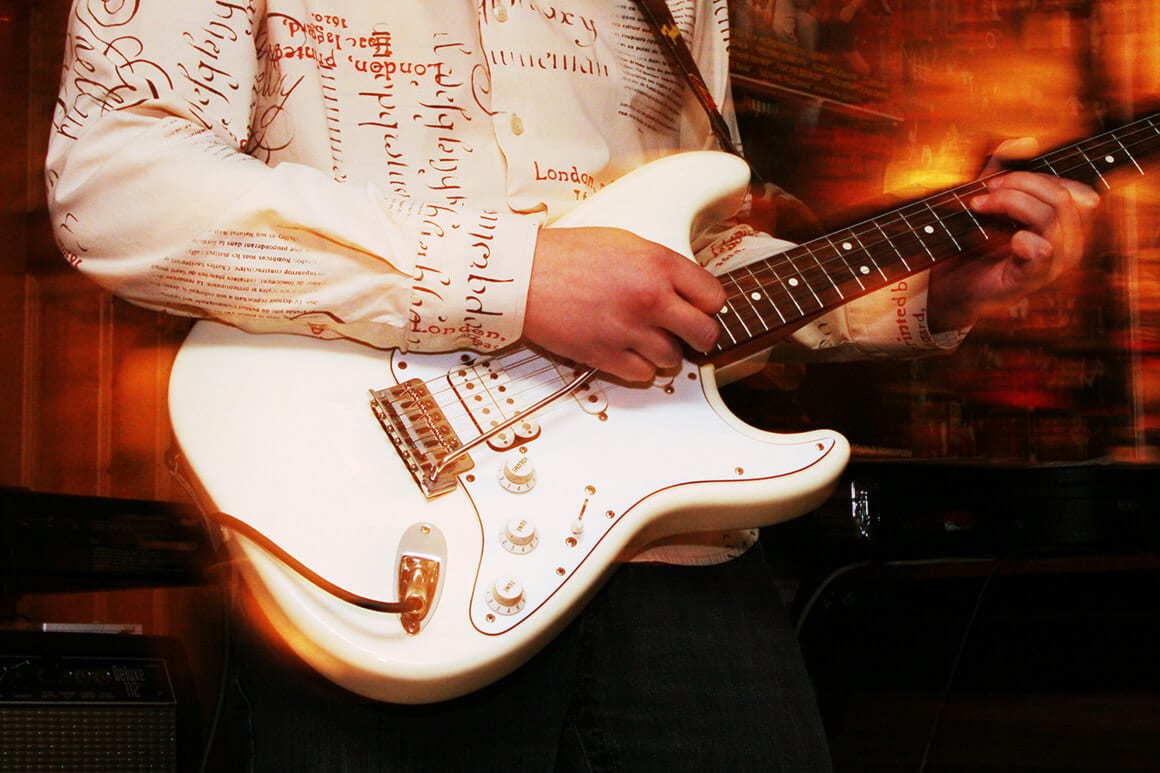
Around 1950, Les Paul and Leo Fender also released very high-quality electric guitar models, including the Fender Telecaster and Stratocaster.