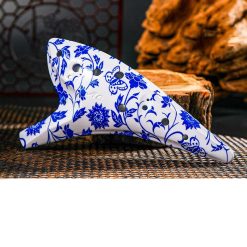
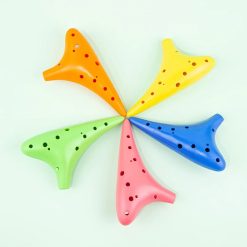
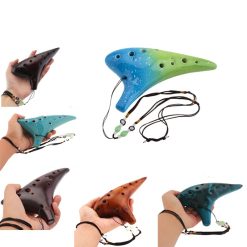
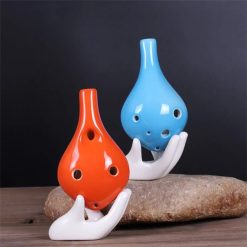
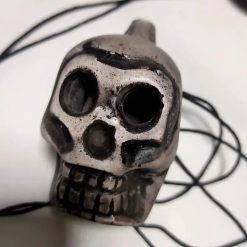
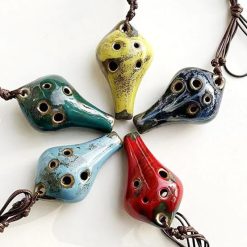
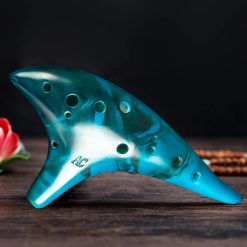
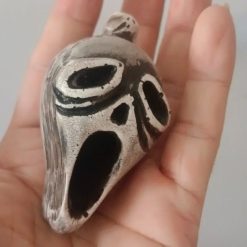
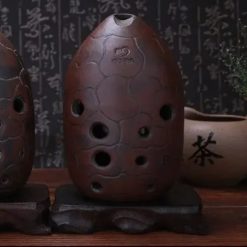
Ocarina: 12-hole ceramic flutes
The ocarina is a ceramic vessel flute whose history can be traced back more than ten thousand years, in China as well as in Central America. It is also one of the most accessible wind instruments there is: a few minutes are enough to draw a pure note from it, and an evening to play a complete melody. Discover our selection of 12-hole ceramic ocarinas, tuned in C, with a soft, round sound, supplied with a neck cord and a fingering chart. Free shipping.
This family of instruments is part of our guitar accessories and complementary instruments range, alongside our kalimbas, harmonicas and kazoos and traditional flutes.
What is an ocarina?
The ocarina belongs to the family of vessel flutes. Unlike a transverse flute or a tin whistle, where the air column vibrates inside a tube, the ocarina makes the air resonate inside a closed cavity. The pitch of the note therefore depends not on the length of a pipe but on the total surface of the open holes. Two practical consequences: an ocarina the size of a palm can reach surprisingly low notes, and the order in which you open the holes matters less than on a conventional flute.
The name comes from Italian and literally means “little goose”, a reference to the shape of the instrument developed in Budrio, near Bologna, in the mid-19th century. But the object itself is far older: the Chinese played the xun several thousand years ago, and Mesoamerican civilisations made clay vessel flutes long before the arrival of Europeans.
Its modern fame owes a lot to popular culture, in particular to a famous 1998 video game that used it in its title. Thousands of players discovered the instrument this way before finding out that it lives up to all its acoustic promises.
Why a 12-hole ocarina?
The number of holes directly determines the range of the instrument and the repertoire you can play.
| Type |
Range |
For whom |
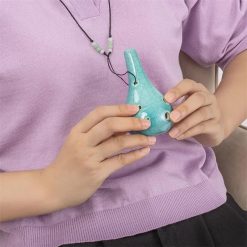
| 4 to 6 holes (pendant style) |
About one octave, often diatonic |
First contact, children, an object to wear around the neck |
| 12 holes (transverse style, known as “sweet potato”) |
About an octave and a fifth, with every semitone |
The worldwide standard: complete melodies, film and game themes, Celtic music |
| Double or triple chamber |
Two to three octaves |
Experienced players, virtuoso repertoire |
The 12-hole is the format to choose if you really want to play, not just blow into a pretty object. Almost all available tablatures are written for it, and its full chromatic scale lets you tackle any key. The pendant format remains an excellent first contact, especially for a child, but its limited range quickly becomes frustrating.
Ceramic, plastic or wood: the material changes everything
The material of the resonance chamber shapes the tone as much as the form does.
- Ceramic is the historical material and remains the reference. Its density produces a pure, warm, slightly veiled sound, with real depth in the low notes. It is the material we have chosen. On the other hand, a ceramic ocarina breaks if it falls on a tiled floor: the supplied cord is not a decorative accessory.
- ABS plastic is unbreakable and unaffected by moisture, which makes it a good choice for travel or for a very young child. The tone is brighter and more direct, but also flatter.
- Wood gives an intermediate sound, woody and soft, but reacts strongly to changes in humidity and needs regular care.
How to play the ocarina if you have never played a wind instrument
This is what surprises beginners most: the ocarina requires no particular embouchure. You do not have to buzz your lips as on a trumpet, nor find the angle of an edge as on a transverse flute. The air duct does the work.
- Place the mouthpiece between your lips, without biting it, and blow gently. The note comes out immediately.
- Control your breath. This is the only real technique to learn: on an ocarina, blowing harder raises the note and blowing softer lowers it. Low notes need a light stream of air, high notes more pressure. Steady breath means steady tuning.
- Cover the holes completely. Use the pads of your fingers, not the tips. A half-covered hole produces an out-of-tune note or a stray hiss: it is the number one mistake among beginners.
- Read a fingering tablature. Ocarina scores come as small diagrams showing which holes to cover. No staff reading is needed.
Allow about ten minutes for your first scale, and one to two weeks of daily practice to play a melody without hesitation.
Which key should you choose?
12-hole ocarinas come mainly in three keys. The alto in C (Alto C) is the universal standard, and the one we recommend without hesitation for beginners: balanced register, comfortable size in the hand, compatible with the vast majority of published tablatures. The soprano in C sounds an octave higher, in a more compact format, with a more piercing tone that carries well outdoors. The bass in C offers deep low notes but requires large hands and already solid breath control.
Caring for your ceramic ocarina
- Wear it on its cord or keep it in a case. Ceramic does not forgive a fall.
- Manage condensation. After a long session, moisture can build up inside the chamber and muffle the sound. Gently shake the instrument with the mouthpiece pointing down, then let it air dry.
- Clean the windway occasionally with a puff of dry air. Never insert a pointed object: the air channel is calibrated to a tenth of a millimetre and the slightest chip changes the tone.
- Avoid sudden temperature changes, which can crack the glaze over time.
- The sound settles after a few minutes of playing, once the instrument reaches the temperature of your breath. Always tune with a warm instrument.
The ocarina, a musical gift like no other
Few objects combine so many advantages as a gift: an authentic, complete instrument, a modest price, a format that fits in a pocket, the look of a handcrafted object and, above all, no barrier to entry. It appeals to complete beginners who have never dared try a wind instrument, to fans of Japanese culture and video game music, to hikers and travellers looking for a portable instrument, and to experienced musicians who add it to their palette for composing.
If you are unsure about the colour or the key, our gift card lets the recipient choose.
Frequently asked questions about the ocarina
Is the ocarina difficult to play?
No. It is one of the most accessible wind instruments: the air duct produces the note without any embouchure work. The only technique to master is steady breath, which determines the tuning. A first melody can be played within a few dozen minutes.
Do you need to read music?
Not necessarily. Ocarina tablatures come as diagrams showing which holes to cover, so you can play without any knowledge of music theory.
How many holes should an ocarina have?
The 12-hole model is the international standard. It offers a full chromatic scale over about an octave and a fifth, which covers almost all the repertoire written for the instrument. 4 or 6 hole pendant models are fine for a first try but quickly limit the repertoire.
What is the best key for beginners?
The alto in C (Alto C) is the recommended key for beginners: its register is balanced, its size comfortable and the vast majority of available tablatures are written for this model.
Is a ceramic ocarina fragile?
Ceramic offers the best tone but can break if dropped on a hard surface. The supplied cord and a case are enough to protect the instrument in normal use, including when travelling.
From what age can you play the ocarina?
From 7 or 8 years old for a 12-hole model, as finger spread is the limiting factor for younger children. A 6-hole model is suitable earlier.
Why does my ocarina sound muffled?
It is almost always condensation that has built up in the chamber after a long playing session. Gently shaking the instrument with the mouthpiece pointing down, then letting it air dry, restores the sound.
Can you play the ocarina in a flat?
Yes. Its volume stays moderate, comparable to that of a recorder, and its soft tone is far more bearable than that of a metal instrument. It is one of the acoustic instruments most tolerable for the people around you.
Continue exploring
The ocarina is listed in our guitar accessories and complementary instruments range. If you like simple, portable instruments you can play straight away, also discover our 17 and 21 key kalimbas, our diatonic harmonicas and our kazoos and traditional bamboo flutes.
For younger players, our selection of children’s guitars and ukuleles extends the musical discovery. And if you already play guitar, browse our guitar straps, capos and picks. Our practical guides are gathered on the Guitar-Strap.com blog.