Traditional flutes and bamboo flutes
The flute is the oldest musical instrument ever identified by archaeologists: the earliest examples found, carved from bone and ivory, date back more than forty thousand years. Forty millennia later, the principle has not changed, and its simplicity is still its strength. Here you will find our selection of traditional bamboo flutes, chosen for the accuracy of their bore and the warmth of their tone: authentic instruments made to be played, not to decorate a shelf. Free shipping.
This family is part of our guitar accessories and complementary instruments range, alongside our ocarinas, kalimbas, harmonicas and kazoos.
How does a flute work?
All flutes belong to the aerophone family. The sound comes neither from a string nor from a reed, but from an air column set into vibration when a stream of air splits against an edge. The length of that column, which you change by covering or uncovering the holes, determines the pitch of the note.
The family divides into two main branches, and the distinction is decisive when you buy.
- Duct flutes (recorder, tin whistle, flageolet) have a mouthpiece that mechanically directs the air onto the edge. You blow, the note comes out. No embouchure technique is needed.
- Rim-blown and edge-blown flutes (transverse flute, Chinese xiao, Japanese shakuhachi, Andean quena, Indian bansuri) require the player to direct the airstream onto the edge themselves. It is more demanding in the first few days, but it opens up unmatched expressiveness: shades of tone, vibrato, sliding notes, audible breath.
The xiao, the Chinese vertical flute
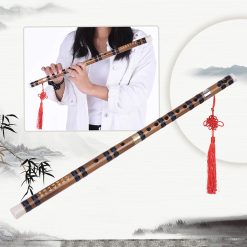
The xiao is a bamboo flute played vertically, held in front of you like a clarinet, with the air directed onto a notch cut into the top end. Its traditional repertoire goes back more than two thousand years in China.
What sets it apart is its tone: darker and more intimate than a Western transverse flute, with a deliberate share of breath in the sound. This slightly veiled, almost melancholic voice explains why it is so widely used in meditation music, Asian film soundtracks and contemporary ambient productions.
The xiao is played standing or seated, with no particular physical effort. Its length, usually between 75 and 85 cm, makes it an instrument with real presence: it is not a pocket item, it is a piece of solid bamboo that you set down and that gets noticed.
The great traditional flutes of the world
| Instrument |
Origin |
Sound character |
Difficulty of the first note |
| Xiao |
China |
Soft, dark, meditative |
Medium (vertical rim-blown) |
| Dizi |
China |
Bright and buzzing, thanks to a thin glued membrane |
Medium (transverse) |
| Bansuri |
India |
Round, warm, very supple in glissandos |
Medium to high |
| Shakuhachi |
Japan |
Audible breath, mineral texture, zen tone |
High |
| Quena |
Andes |
Clear, piercing, very recognisable |
High |
| Recorder |
Europe |
Neutral, direct, few nuances |
None (duct flute) |
Getting your first note on a bamboo flute
Let’s be honest: unlike an ocarina or a kalimba, a rim-blown flute does not sound on the first try. Allow a few minutes to a few days to get a stable note, then one to two weeks to hold it effortlessly. This stage is the only real difficulty of the instrument, and everyone gets through it.
- Rest the notch against your lower lip, without covering it. The edge of the opening should sit in the hollow of your chin, with the instrument tilted slightly forward.
- Blow a thin, focused stream of air, as if making the rim of a bottle sing. It is not about power: a strong, badly aimed breath gives nothing, while a light, well placed stream gives a full note.
- Find the angle through tiny adjustments. Gently roll the instrument back and forth while blowing: the note suddenly appears. Memorise that position, and your body will find it faster and faster.
- Cover the holes with the pads of your fingers, never with the fingertips. A badly closed hole produces a stray hiss or an out-of-tune note.
- Work on long notes before melodies. Ten minutes a day holding a single note will make you progress faster than an hour stumbling through a piece.
Caring for a bamboo flute
Bamboo is a living material, which is what makes the sound beautiful, but it calls for a few simple precautions.
- Avoid thermal shocks. Do not play an ice-cold flute: warm it up in your hands for a few minutes. This is the main cause of cracks.
- Dry the inside after every session with a cleaning rod or a thin cloth. Residual moisture is bamboo’s enemy.
- Oil the body two or three times a year with a neutral vegetable oil, in a very thin layer. The bamboo stays supple and copes better with changes in humidity.
- Store the flute flat, out of direct sunlight and away from radiators.
- Never force the reinforcement rings: they are there to contain the natural tension of the bamboo, not to be tightened.
Which flute should you choose for your profile?
You have never played a wind instrument and want instant results. Start with an ocarina, whose air duct produces the note without any embouchure work. You will come back to the rim-blown flute with an already trained ear.
You are looking for an instrument for meditation or relaxation. The xiao is a particularly coherent choice: its deep, veiled tone, its slow breathing and its vertical position make it an instrument that invites calm rather than virtuosity.
You are a guitarist and want to broaden your palette. A traditional flute brings a melodic colour that a guitar neck cannot produce: sustained lines, breath, micro-variations in pitch. It is an excellent instrument for composing and a natural complement when recording.
You are looking for a gift. A bamboo flute is a handcrafted object with immediate presence, and its price bears no comparison with that of an equivalent classical instrument. If you are unsure, our gift card lets the recipient choose.
Frequently asked questions about traditional flutes
Is the bamboo flute difficult to play?
The only real difficulty is the first note. On a rim-blown flute such as the xiao, you have to learn to direct the airstream onto the edge yourself, which takes anywhere from a few minutes to a few days. Once that step is behind you, progress is quick and the instrument becomes very expressive.
What is the difference between a xiao and a transverse flute?
The xiao is blown vertically, with the air directed onto a notch at the top end of the instrument, whereas the transverse flute is held horizontally and blown across a side hole. The xiao produces a darker, more intimate tone, with an audible share of breath that gives it its character.
Do you need to read music?
No. Fingerings for traditional flutes are learned from charts, and many visual tablatures are available for free. Music theory helps but is by no means a prerequisite.
How do you care for a bamboo flute?
Dry the inside after every session, avoid thermal shocks by warming the instrument in your hands before playing, oil it two or three times a year with a neutral vegetable oil, and store it flat, away from direct sunlight and heat sources.
Can a bamboo flute crack?
Yes, mainly because of sudden changes in temperature or humidity. Warming the instrument before playing, drying it after use and oiling it regularly is enough to prevent almost all cracks.
Is the xiao suitable for a complete beginner?
Yes, provided you accept a few days of learning the embouchure. Its slow breath and low register even make it a more forgiving instrument than the quena or the shakuhachi, which are known to be far more demanding.
Can you play a bamboo flute in a flat?
Yes. Its volume stays moderate and its tone soft, without the piercing harmonics of a metal flute. It is one of the wind instruments most bearable for the people around you.
Which key should you choose?
Traditional bamboo flutes are tuned to a fixed key, often F or G for the xiao. A longer flute sounds lower and requires a wider finger spread; a shorter flute is higher pitched and easier to cover for small hands.
Continue exploring
Traditional flutes are part of our guitar accessories and complementary instruments range. If you enjoy world instruments with a soothing sound, also discover our 12-hole ceramic ocarinas, our 17 and 21 key kalimbas, our tongue drums and our diatonic harmonicas.
To introduce a child to music, our selection of children’s guitars and ukuleles and our kazoos offer a more immediate way in. And if you already play guitar, browse our guitar straps, capos and picks. Our practical guides are gathered on the Guitar-Strap.com blog.